
Net Zero Energy Roadmap Update | Darren Springer
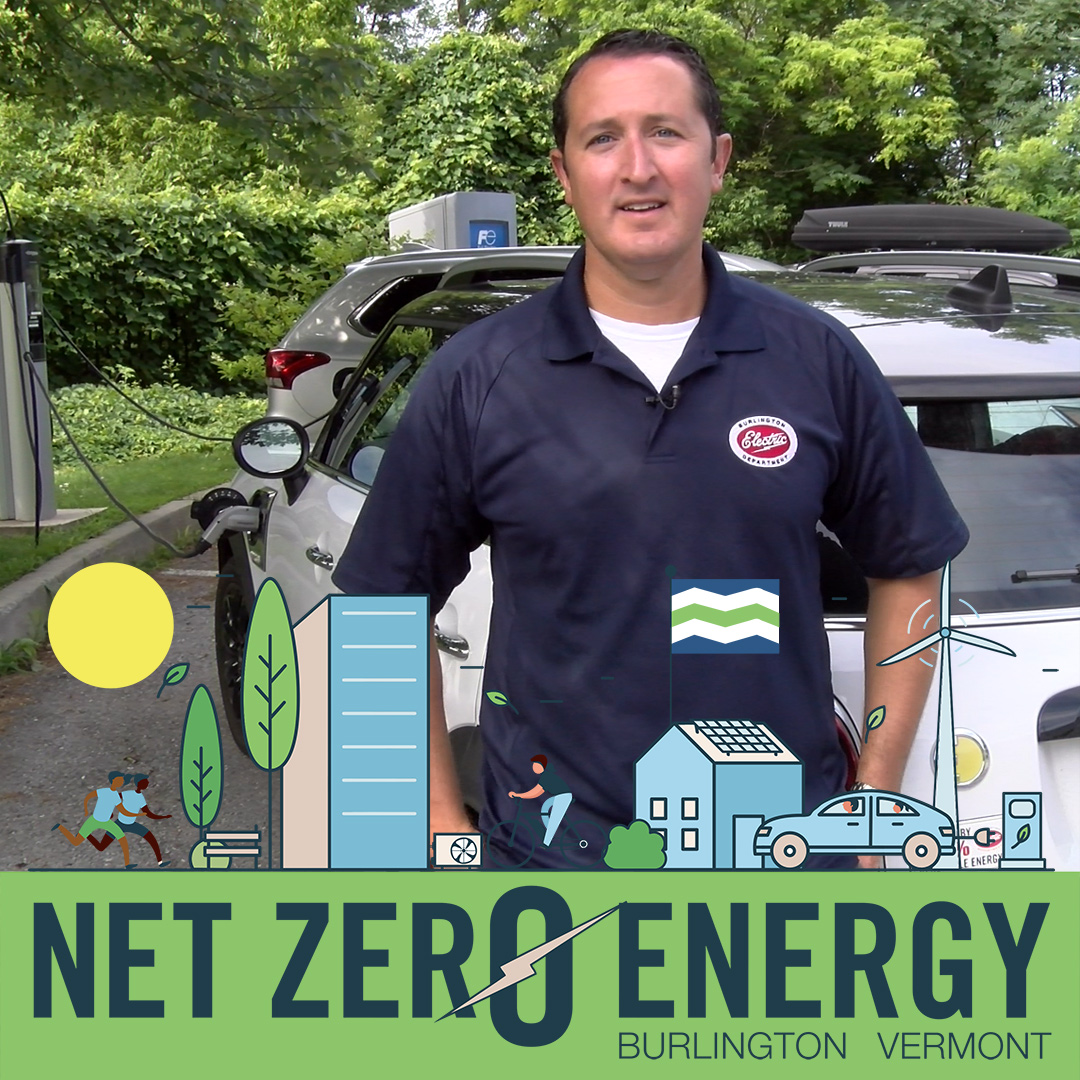
Darren Springer, General Manager of Burlington Electric Department, joins the program to share the latest progress on the city’s Net Zero Energy roadmap. This episode explores a remarkable 24.3% reduction in local fossil fuel consumption for ground transportation. Discover how expanded electric vehicle incentives and thousands of heat pump installations are transforming Burlington into a sustainable leader. Residents can also learn about Sparky, the new AI chatbot designed to simplify rebate access, and the addition of high-speed chargers downtown.

/
Darren Springer, General Manager of Burlington Electric Department, joins the program to share the latest progress on the city’s Net Zero Energy roadmap. This episode explores a remarkable 24.3% reduction in local fossil fuel consumption for ground transportation. Discover how expanded electric vehicle incentives and thousands of heat pump installations are transforming Burlington into a sustainable leader. Residents can also learn about Sparky, the new AI chatbot designed to simplify rebate access, and the addition of high-speed chargers downtown.
Transcript
00:00 Jennifer Green: Hello, Burlington and welcome to Net Zero Energy. I’m Jennifer Green, director of sustainability for the City of Burlington, where our goal is to reduce and eventually eliminate fossil fuel usage. Today we have Darren Springer with us. Darren is the general manager of BED and here to talk about where we are on our Net Zero Energy roadmap. Darren, it’s a pleasure to have you.
00:32 Darren Springer: Great to be back on my favorite podcast.
00:34 Jennifer Green: Thanks, Darren. I think this is maybe your third time as a guest and we always appreciate hearing from you.
00:40 Darren Springer: Thanks, Jen.
00:41 Jennifer Green: So today we want to talk about the Net Zero Energy roadmap, which was ratified by the City Council in 2020, which is essentially a plan to transition away from fossil fuels in buildings and ground transportation. And it’s something that I know, Darren, you keep a close eye on and you monitor annually with our friends from Synapse Energy Economics. Can you tell us about that relationship to start?
01:06 Darren Springer: Yeah, absolutely. So really dating back to the 2018 2019 time frame, we started work with Synapse Energy Economics from Cambridge, Massachusetts, and RSG, which specializes in transportation. And we tried to define how can we tackle the two biggest sectors of greenhouse gas emissions in the state of Vermont and two of the biggest nationally and internationally, which is our transportation. And in Burlington, we’re specifically focused on our ground transportation and our heating and thermal sector, which is essentially the energy that we’re using in buildings to heat and for other processes. And we had a really strong process with synapse leading to the creation of the Net Zero Energy roadmap, which details a variety of policies and initiatives we could pursue to make a significant dent and eventually eliminate our usage of fossil fuel, which is the dominant source of human caused greenhouse gas emissions in these key sectors. And since 2020, we’ve been tracking our progress relative to that 2018 2019 time frame baseline. And every year since then, we’ve issued an update around the April time frame. Once we have data from the prior year, and we just did that recently, there’s a press release on the BurlingtonElectric.com website where you can read about all the results, and we briefed the City Council as well just recently.
02:30 Jennifer Green: What are the key highlights?
02:32 Darren Springer: A few things that really stood out this year. So the first, as a really positive thing we have seen since 2019, a 24.3% reduction in consumption of gasoline and diesel estimated for Burlington residents and Burlington customers relative to our 2018 2019 time frame baseline. So almost a quarter reduction. And so how did how do we achieve that? Certainly vehicle miles traveled per vehicle are a little bit lower now even than they were pre-pandemic. They were certainly very low during the 2020 time frame during the pandemic. And then they they bounced back, but not all the way back. So we’re still seeing a little bit less vehicle miles traveled per vehicle. Certainly, we are seeing less vehicles overall being registered in Burlington, which speaks to living in a well-designed, compact land use style community where we can walk, we can bike, we can take transit. That’s a benefit. People may not need to own as many vehicles, or they may be able to use Car Share and other services to supplement. And perhaps most importantly, we’re seeing fewer gasoline and fossil fuel vehicles registered and more electric and plug in hybrid vehicles registered. So in Burlington, as of 2025, over 6% of our fleet as a whole is plug in hybrid or electric, which it may not sound like a lot, but that’s an over 500% increase from when we started in 2018 2019. So we had relatively few vehicles that were electric back then. We’re growing at a fairly exponential rate from a small base, and we’re continuing a good trajectory there. Certainly, we’ll need to think about the federal policy headwinds in that space, because EV incentives at the federal level and also at the state level have been essentially wiped out. We don’t have funding for those anymore in either case. But Burlington Electric last year announced that we’re going to boost our EV incentives from what they were at $2,300 per vehicle, up to $5,000. And if your income qualified customer, you can get $5,700. And if you drive a significant number of miles, we have a high mileage driver enhanced incentive as well. So we’re doing everything we can in that space to support our customers. Because we know particularly right now, if you look at the price of gasoline, you know, $4.50, you know, $5 a gallon, that is significant. And so putting aside the very, very significant climate benefits that we see and we want from driving electric, there’s also a huge cost savings to customers, even when gas prices were $2 or $3 a gallon. Now, at $4.50 or $5 a gallon, we’re looking at a significant benefit for drivers who can drive electric.
05:02 Jennifer Green: We just heard from the American Lung Association that Burlington is, what, the fourth or fifth cleanest air in the country. And actually, interestingly enough, I was just on a webinar with the mayor and the American Lung Association, and they gave us a big shout out. So yeah, this is cool too.
05:18 Darren Springer: Yeah, it’s I mean, when we are able to switch from driving with gasoline to driving with electric, there’s all the benefits you just mentioned. We’re also keeping more dollars in our local economy because when you spend a dollar at the gas station in Vermont, about three quarters of that dollar leaves, the state economy goes somewhere else. When you spend a dollar with your electric utility like Burlington Electric charging a vehicle, we know that almost two thirds of that dollar stays in state as part of our economy. So it’s a buy local opportunity. It’s lower emissions. It is savings in terms of fuel and maintenance. There’s just so many benefits in terms of driving electric.
05:50 Jennifer Green: Yeah. Okay. So you said 24% drop in.
05:53 Darren Springer: Yes, 24.3% lower in 2025 in terms of gasoline and diesel consumption for vehicles than we had back in 2019. So that that was really good news. We also, for the first time this year, had what we call weather normalized data on the thermal side. So taking out the weather variability that we see, was it a cold winter? Was it a hot winter and getting a little bit more of an underlying trend in terms of how we’re doing. We know that we have over 3,400 heat pumps installed in Burlington, a number of which have, or pretty much all of which have had some sort of incentive from Burlington Electric, either through our efficiency program or other programs that we have called tier three. And what we’re seeing as well is more customers are looking at induction cooking and heat pump dryers, heat pump water heating. So we’re starting to make a dent there. We have city policies like around rental weatherization and carbon fee ordinance that are also impacting the building sector. However, what we saw in 2025 was It was a colder winter than it was in 2024 or 2023. So our downward trend on thermal emissions, which had had taken place over a period of years, we saw a modest rebound in 2025. The weather normalized data showed a steadier trend, but because of that, we had a little bit of a rebound in 2025. That’s to be expected if we have a colder winter, and we’ll look ahead in 2026 and see if that trend keeps on the downward trajectory and what kind of outcomes we’re having there.
07:18 Jennifer Green: I know that we often look at the IPCC as a metric of success. Can you talk about that? What is the IPCC?
07:26 Darren Springer: Yeah. So IPCC is the Intergovernmental Panel on Climate Change, and they came out with a science based target for emissions reduction using also a 2019 time frame. So it coincided with when we were working on the roadmap. At the end of the presentation. You can view online at BurlingtonElectric.com/nze for Net Zero Energy, you can check out this update. We have a slide that shows how our emissions reduction is comparing to the IPCC. Last year we were really very much on track with the IPCC due to that thermal sector rebound. We’re a little off track this year. We’re hoping to get back on that trajectory. It’s really important to keep in mind, though, because we look at these targets. They’re very ambitious, whether it’s IPCC or Net Zero Energy. Our community is doing as much, I think, as almost any community in the country, in having a variety of initiatives aimed at helping people to switch from fossil fuels to electric. We are 100% renewable when it comes to our electricity. Since 2014, and we are looking at a variety of policies as well in the city. And so when you cut the ground transportation, fossil fuel use by almost a quarter, that’s a result that a lot of communities would be really excited about, for example. It’s always important to keep ourselves accountable for continuing to make progress. But it’s also important that we celebrate when we’re seeing some success. And I think the Net Zero roadmap project, if you would look back to 2018, 2019 and said, hey, we’re going to have reduced ground transportation, fossil fuel use by almost a quarter by 2025. I think people would have looked and said, hey, that’d be a pretty good result.
08:58 Jennifer Green: Given my connection to the Urban Sustainability Directors Network, I often hear from other cities that want to know, like how we’re doing it. And honestly, they’re really envious of the fact that we have a municipal electric department with a diverse portfolio of resources that also keeps us resilient. I mean, this is kind of an interesting theme because the mayor’s been talking about this more and more. Not only do we want to continue to mitigate greenhouse gases, but we want to adapt to climate change and be resilient for when we do have those those climate challenges.
09:29 Darren Springer: Yeah. One of our sister cities, Ann Arbor, Michigan, also has had a Net Zero Energy 2030 style initiative. And they have they do not have a municipal utility. They’ve been talking about trying to have municipal utility, and they’ve launched an innovative program to provide solar and batteries in certain neighborhoods. So it’s always interesting to learn kind of what’s going on in other communities. But, by having a municipal electric utility like we do in Burlington, we can offer efficiency programs, we can offer electrification rebates, we can be 100% renewable instead of relying on fossil fuels for our, our energy needs in the electricity space. The other piece is we’re doing this in a way that is very competitive from an affordability standpoint. If we want people to switch to electric for driving and for heating, we have to keep the rates reasonable and affordable. This year, we’re going to have a proposed 2.99% rate change, which is our lowest since the pandemic. And at the national level, electricity prices are going up over 6% on an annualized basis. And we’ve seen rate changes that have been double digits or in some cases, triple digits over the last few years. So keeping our rate changes in the low to mid single digit range, predictable, moderate at a time when inflation and electricity prices have been under a lot of pressure. That’s a real benefit to to having our municipal electric department working on these different initiatives, trying to keep costs affordable for customers so that everybody has access to the programs and the offerings and making it equitable.
10:58 Jennifer Green: I really appreciate your emphasis on equity, Darren, because we know that unless we keep prices low, we don’t enable everybody to participate in our programs, i.e. take advantage, say, of the used EV rebate.
11:10 Darren Springer: Yeah, it’s one of the most important things. One of the things I love about the idea of having this very ambitious Net Zero Energy goal is we do not succeed unless everyone in our community can participate. So we have to think about things like having our energy assistance program, where we can discount our bills for income qualified customers, having enhanced incentives that are larger for our income, qualified customers working on policies like rental, weatherization, and others that will help in this way, having a community charging that drops down from an electric pole and is accessible for on street parking. If you are a renter and you don’t have off street parking, and making sure that that rate is a competitive off peak rate, just like it would be if you were, driving and charging at a single family home. So we have to think about all of those things to be successful here and being, equitable in terms of our offerings, making sure everybody can participate and doing a bunch of work, as I know you know, about Jen, you and Etta with various videos that are helping our customers understand weatherization, understand their electric bill and translating those into 18 or 19 languages. There’s a lot of great work happening in the equity space at Burlington Electric, and I couldn’t be prouder of that.
12:20 Jennifer Green: So this is exciting news about the roadmap update. Anything else from the synapse report you want to share?
12:26 Darren Springer: Yeah. I think, one of the things that I always look at is not just what’s going on in Burlington, but but I look statewide, I look nationally, and one of the things we compared was how our progress looks compared to the state and national trend. And it wouldn’t surprise you to know that when you look at transportation, for example, we have about three times the reduction in Burlington that we’ve seen statewide on on ground transportation fuels. And obviously, even more reduction compared to the national level. For example. So I think it’s important to have that context. It’s also important to remember when you look at the Vermont emissions inventory, roughly 8 million metric tons of emissions, greenhouse gas emissions in Vermont in that inventory, in a typical year, 70 to 80% of it is coming from the transportation and the buildings thermal sectors. Those are the sectors the roadmap focuses on. That’s the reason why we focus on those sectors. Vermont is said to have one of the cleanest electric grids, really in the country. When you look at the supply, Vermont is said to be. In recent analysis, I saw in the New York Times one of the least vulnerable to natural gas price disruptions on electricity prices, because we have had a policy of being long term, stably priced renewable energy in the electric space. So we have to think about the statewide context and remember that if we want to go after the biggest sources of emissions, the biggest sectors of emissions in Vermont, and it’s true nationally as well, you’re talking about ground transportation and other transportation sources. You’re talking about heating and other building energy uses. And that’s where the roadmaps focused. It doesn’t cover everything. And there are different aspects to the climate work that are covered in other places. But Burlington Electric’s focus is really on reducing the emissions in those two sectors.
14:07 Jennifer Green: Well, a big shout out to our policy planning team, because I know they work hard to ensure that our portfolio remains renewable. There’s there may be this misnomer that there are just tons of renewable sources out there that we can buy into or tap into to meet the demands of Burlington. I don’t think that’s the case. Is that so, Darren?
14:25 Darren Springer: That’s fair. I mean, I think we’re in the market. We talk with a lot of different renewable energy vendors. We’ve done RFPs in recent years. And unfortunately, we’re in an environment where the federal administration is literally paying companies that had offshore wind leases in the northeast to cancel their leases, take their money and go drill in Louisiana and Texas and other places. When you think about trying to have renewable energy access for electricity in New England at an affordable level, that’s hurting us big time. So our team does a bunch of work to make sure we can find affordably priced contracts for things like wind or hydro, other resources. We have a diverse mix that includes wood through the McNeil plant, but also includes hydro that we own and operate, hydro that we purchase when that we purchase solar, that we both own and operate and purchase. And you really need a diversity of resources as well as, a savvy team that can find the right contracts at the right times to keep yourself 100% renewable, not just attain it, but, but keep it. And that’s been an important part of the work.
15:27 Jennifer Green: So Darren just put out a press release sharing the new data from the synapse report. There’s some other stuff in that press release. Do you want to tell us about that?
15:36 Darren Springer: Yeah, absolutely. Well, first of all, we have two new fast chargers that are located downtown Saint Paul and Bank right near the new development. The AC hotel and jitters right in that little corner there. We’ve got two fast chargers that can charge at up to 125 kW rate, which are the fastest that we have in our public network so far. So we’re really excited to announce those are available to drivers in Burlington. And also, and I think we might be maybe the first utility in Vermont or maybe one of the first, nationally to do this. But we have a new customer support AI chatbot on our website named Sparky. You can go to BurlingtonElectric.com and check out there’s a green bar at the bottom that says Chat Now, and you can talk to Sparky and ask about EV incentives and say, hey, I’m interested to learn more about induction cooking or what types of programs do you have available for heat pumps? And if I make this much, what am I eligible for? Can I get an enhanced incentive? All those types of questions and more Sparky can answer. And our own talented Adam Rabin helped to code Sparky for our website, and we’re really hopeful that customers who need some information can cut right to the right part of our web pages and part of our information by talking to Sparky and get the rebates that they want to get.
16:53 Jennifer Green: So Darren Sparky uses AI. Talk a little bit about that and what that means for for us and electric load.
17:00 Darren Springer: Well, certainly AI is a big topic of conversation nationally. Data centers a big topic of conversation nationally. There’s also legislation that’s pending in Vermont that may regulate how data centers, if they were to locate here, can can do so in a way that meets our energy and renewable energy and climate and water goals for the state. Those are really important conversations to have. We’re certainly conscious of the potential impacts that AI can have. What we’re hoping to do is take what is a newer technology and use it for good purpose, which is to help our customers learn how they can switch to an EV or a heat pump or other types of technologies. E-bikes and things like that. So Sparky on our website is really geared at helping our customers learn more about how they can make the switch or how they can support Net Zero Energy in their own lives, and what sorts of resources Burlington Electric can offer to help. And, our website, like any website, has a lot of information on it. And by being able to cut right to the right point with Sparky and say, okay, I’m interested in learning about induction cooking. Can you take me right to that page and tell me what you have to offer and get a concise response? We think that has some value, and we’d like to pilot that with our customers community, and we’ll take feedback and refine it as we go.
18:14 Jennifer Green: Thanks, Darren. Well, that covered a lot. Is there anything else you want to leave our listeners, something that we may not have touched?
18:21 Darren Springer: Well, just honestly, this is an effort with the Net Zero Energy roadmap that doesn’t work without our customers, without our community participating. So really any achievements that happen here are achievements that our community is making, that our individual customers are making in their homes and businesses, at non-profit organizations around the community. And so I thank them for being on this journey with us and for, stepping in and trying some of these newer technologies and innovating with us and showing that the cheaper and cleaner fuel like electricity for electric transportation can be an option you can use as a customer, whether it’s a used EV or a new EV or a plug in hybrid. And we really thank our customers for all their support in these initiatives.
19:03 Jennifer Green: Well, Darren, it was a pleasure to have you on the Net Zero Energy podcast. Thank you so much for being here.
19:08 Darren Springer: Thank you.
19:10 Jennifer Green: Thank you again for listening to Net Zero Energy from Burlington Electric Department. If you have any questions about this show or what BED offers regarding rebates or technical support, look for us at BurlingtonElectric.com or call us at 802-865-7300. We’re here to help you on our mutual path to Net Zero Energy.