
Power Purchasing | James Gibbons

/
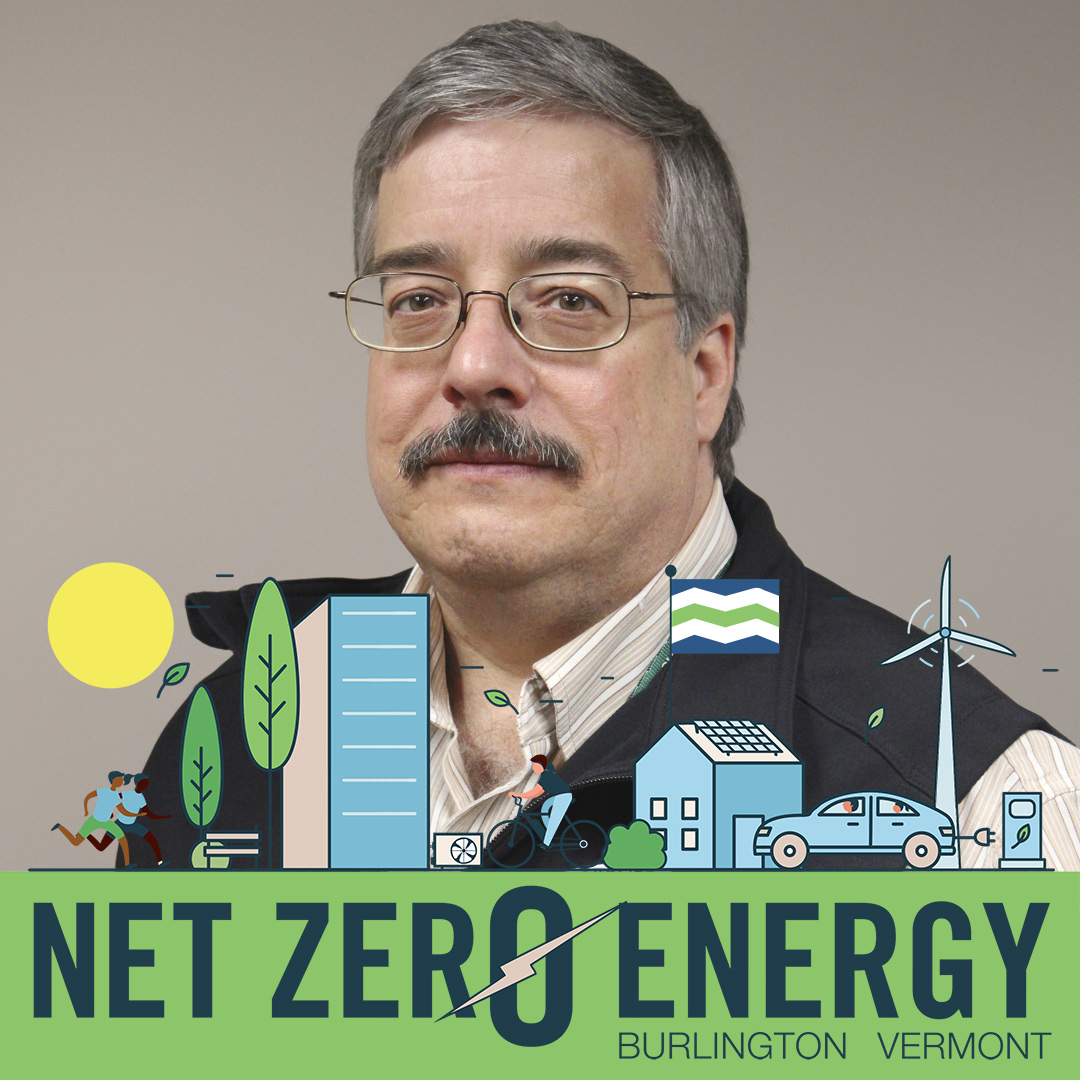
James Gibbons, the Director of Policy and Planning at Burlington Electric Department, joins Net Zero Energy to pull back the curtain on managing a 100% renewable energy portfolio. Discover how Burlington balances internal resources like the McNeil Station and Winooski One hydro plant with external power contracts to keep your lights on sustainably. Gibbons shares insider insights into navigating complex regional energy markets, dealing with global supply chain disruptions, and keeping local electric rates affordable for our community.
transcript
00:00 Jennifer Green: Hello, Burlington and welcome to Net Zero Energy. I’m Jennifer Green, director of sustainability for the City of Burlington, where our goal is to reduce and eventually eliminate fossil fuel usage. We’re really happy today to have our own James Gibbons on this podcast. James is the director of Policy and planning, and James can really talk to us about what it means to have and maintain a renewable energy portfolio. James, it’s great to have you.
00:37 James Gibbons: Well, thank you very much for having me.
00:39 Jennifer Green: James, before we really get into what our renewable energy portfolio is and how we keep it up and where we source energy from and how it’s produced. Tell us what you do as the director of policy and planning. It’s a big, big job.
00:52 James Gibbons: My portfolio, the portfolio my team does. I don’t, thank God, do all of this myself. I would not function if I did is very broad. As you said, in many ways, it’s kind of all of the back office functions that are not accounting and finance or IT. So it includes transmission legislation, regulation, designing electric rates, renewable energy trading, energy trading, the interface with the wholesale markets in New England. And I’m probably forgetting stuff, quite frankly.
01:27 Jennifer Green: I really appreciate that because I think it’s a message to our listeners that when you flip on the lights, there is so much that goes on behind the scenes.
01:35 James Gibbons: And certainly, I would add that Vermont is somewhat unusual in that it fully regulates municipal utilities like Burlington in most states in the United States. The municipal utility regulation stops at the local level. So if there is something, for example, in rates or power supply that the local government wants to do, it may do so in Vermont. Those things typically have to also be approved at the state level. They don’t they don’t avoid the local approval. They add the state approval. So most of the things we do do go through multiple layers of screening, both at the electric commission, potentially at the City Council, depending on what type of action it is, and then at the state level for most things as well.
02:12 Jennifer Green: And that would be the Public Utility Commission that oversees us.
02:15 James Gibbons: The Department of Public Service, functioning as the consumer advocate on behalf of consumers and the Public Utility Commission, being the quasi judicial body that makes determinations about those things.
02:26 Jennifer Green: So, James, let’s let’s transition a little bit and talk specifically about our renewable energy portfolio and remind listeners that in twenty fourteen, big year, that was the year that we officially sourced all of our electricity from renewables, solar, wind, hydro and, and wood. Is that correct?
02:43 James Gibbons: That’s where we had enough contracts in hand or owned assets in hand to theoretically provide all of our renewable energy needs on an annual basis. That does not mean that in every hour of the year, we have enough renewable energy. But it means that for every hour where we don’t have enough, we have another hour where we have too much such that on an annual basis, we are capable of serving our loads with renewable energy. We started really probably in twenty ten, vintage give or take with signing a number of win contracts like Georgia Mountain Community Wind, Sheffield Wind, and then adding Winooski one was sort of the last piece on closing out our external contracting and turning it over to renewable energy. So we have a portfolio that’s made up of a mixture of owned assets and contracted assets. Generally speaking, we own assets that are in the city of Burlington. We try not to own assets that are outside the city of Burlington. Burlington Electric doesn’t really want to be in the position, or at least under my under my tenure here, has not wanted to be in the position of going to another city or town and saying, you need to build a renewable generating plant in your town to serve our needs. We have been willing to build generating plants in Burlington to serve our needs. So for roughly half of our energy needs, we are met. Those are met by internal resources. So Winooski one is a is a big resource. It’s the hydro plant on the Winooski River between Burlington Winooski that you see on the bridge at the bottom of the hill by the hospital. The McNeil generating station, of which we own half of. But we also operate it fully and. We also have a couple of solar plants, and we have a gas turbine that we are converting to renewable fuel. So roughly half of our energy comes from In-city half comes from our city. The outer city are contracts, not owned resources. That’s really where we break the line. We also have some contracts for solar in the city. If somebody wanted to own a solar in the city and asked us to sign a contract for it, we have done so. So things like Hydro-Québec, Georgia Mountain Community Wind, Sheffield Wind, Hancock Wind, the recent relevant power contract, the recent Brookfield Power contract for the Hydro in Maine. Those are all contracts. And one of the other things that’s come up recently is, you know, why don’t you invest in more generating resources? Well, as I mentioned, you know, we we try not to own assets outside the city of Burlington. That doesn’t mean that we are not supporting the development of assets outside of the city of Burlington. So, for example, Georgia Mountain Community Wind was built on the basis of a contract with Burlington Electric Department. We were discussing with them before they ever had a permit to build the plant. And then when they go to build the plant and they need to take out debt to create the plant, they can use our power contract as a evidence of their ability to pay that debt. So we can support contract. We can support renewable generation either by building it ourselves again, ideally in the city or by being willing to take a long term position to buy the power, which the developer can then use to support their financing of the project.
05:43 Jennifer Green: I would imagine that’s pretty unusual for a city to be able to source that much from within its own boundaries. Is that true?
05:45 James Gibbons: Well, Vermont is a net importing state anyway, so the McNeil Generating Station is the largest energy producing resource in the state of Vermont. So and because we own half of it, that’s a pretty significant, you know, injection of power to our system.
05:57 Jennifer Green: So can we talk about the energy that we contract from outside the state? I know there was just a press release that came out about the contract, and it’s a power purchase agreement. So we throw around this term PPA. Can you describe what a PPA is and how it works with our the energy that we’re going to source through Relevate?
06:18 James Gibbons: Sure. A purchase power agreement is just that it’s an agreement to purchase power from a particular asset, typically. I mean, it could be a generic contract that says I will buy generic energy, but we don’t do those. All of our contracts are really tied to specific assets. So in order to claim Renewability, I think it’s important that you be able to say, I am buying renewable energy from a certain plant. So I can’t think of an exception to this, which is that all of our contracts are purchase power agreements. They cover energy from a specific resource. They cover the Renewability and the renewable energy credits or other attributes from that resource. They may also include the capacity, which is the maximum production capability of a generator and other market products too. We try to get essentially what I would call a slice of the unit, which is a piece of everything the unit provides. In the case of Georgia Mountain Community Wind, it’s one hundred percent of everything the unit provides because it’s only a ten megawatt unit. In the case of Sheffield, it’s a much bigger unit and we get forty percent of and we get everything the unit creates. So we try to slice a unit either one hundred percent, forty percent, ten percent, some number. But of everything unit provides.
07:31 Jennifer Green: Sourcing, producing and sourcing enough electricity to meet our demand is a big puzzle with lots of moving pieces. What’s the market like out there and how hard is it to to buy what we need, source what we need?
07:45 James Gibbons: Well, I guess I would say it’s it’s so far, it has proven to always be possible to source what we need. If you were to say, I don’t care what the cost is, sourcing what we need and keeping the costs under control, that has been a little bit more challenging. And you might not think about renewable resources being affected by natural gas and things like that, but they absolutely are. So for example, we had a contract fail. We had closed the contract. We agreed to all the terms. And because of a problem with the other party. That contract failed. That put us out in a scramble to purchase a replacement energy. Well, unfortunately, doing that around March of this year meant that the disruptions in the Persian Gulf were affecting the wholesale energy markets. Anybody who’s selling power from an existing plant looks at those wholesale energy markets. When they price their commodity to you, they’re going to take the view that if I don’t sell it to you, I can sell it to the wholesale energy markets. And if those markets are currently high priced, they’ll pass that through to us. Once you’ve signed the contract, the price is not going to usually fluctuate based on those things. But if you’re actually negotiating a contract at the time when things disrupt the energy markets, that can be pretty ugly. And that’s what happened sort of this spring was replacing contracts, but not at the best time we could. Well, that can lead you into things like, well, maybe I shouldn’t replace this contract for as long, or maybe I shouldn’t buy as much as I would otherwise buy right now and hold open some position to act again if the markets soften. So it can be it can be both challenging to find those resources to some extent, but it can be extremely challenging to get them at a price that you will can live with. And that will not cause rate pressure that you don’t want to see.
09:30 Jennifer Green: Right. So how did that sugar out for us during that March timeline?
09:34 James Gibbons: We ended up signing contracts for one contract for ten years, which the price had been negotiated prior to the disruptions in the market. So it wasn’t affected by it for the contract that we had to sign after the disruptions in the markets, we signed a shorter term. And so we’re going to see it’s a five year term. It’s only for a part of our needs. So we’re not we try very much not to have everything expire at the same time so that we’re never replacing, you know, the half that we buy contracts for all at once. And we will hope that the market softens. Now, if the market does soften, we could act sooner. We don’t have to wait till the end of the five years to take the next step. And so we will be watching the markets to see if we can move earlier than the five years this time. But frankly, the. The impact of the Persian Gulf incident was not anticipated. Obviously, at the time we needed to replace signed the contract that needed to be replaced in the spring.
10:27 Jennifer Green: You know, here we are operating at the local level, but global ramifications impact the way we do business and how it impacts potentially how it impacts ratepayers, which really gets back to sort of an equity question. We want to keep rates as affordable, as low as we can for all our customers.
10:43 James Gibbons: We do. But we also recognize the benefits of renewability, and there are benefits of renewability that are sort of not obvious to everybody. So, for example, if we have a one hundred percent renewable portfolio, all of our energy comes from resources. We get increased credit under state law for anybody who changes to an electric vehicle or who takes their fossil fuel heat for their house and converts it to electric heat. Why? Because they’re replacing the fossil fuel with energy that is one hundred percent renewable. So that has a value to us. We get more credit for every action we take by having a one hundred percent renewable portfolio. If we also have one hundred percent renewable portfolio, we’re exempted from certain state purchasing that is required of utilities that don’t have one hundred percent renewable portfolios. And those are actually at more expensive prices than what we had to pay even recently. So we would prefer to be making our own decisions and not relying on essentially state mandated purchases at fairly high prices. So there are significant benefits to renewability in that respect, but they carry the challenges of being only able to seek sort of a limited pool. In other words, you can’t go look for the cheapest price at any given time. That’s likely to be likely to be a natural gas based generating resource with no renewability. But we will not typically seek those generating resources. We will be seeking amongst the pool of available renewable resources to fill our portfolio.
12:10 Jennifer Green: Yeah, and that is not likely to change. This is something that the people of Burlington have decided is the right approach. Our commission, obviously, and others. And so as long as it’s possible, we’re going to stick with renewable sources.
12:23 James Gibbons: That is my instruction. Yeah. So, you know, again, I’m not I’m not the general manager, nor am I the city council or the mayor. But those are the instructions that I’ve been given. And so what I’m attempting to do is within that instruction, making the electricity as affordable as possible. And so, you know, that’s, that’s the challenge. It’s, it’s, it’s constraining what you can seek, but making sure you do it as affordably as you can do.
12:48 Jennifer Green: James, your job is so important and I’m so grateful that you’re here. Burlington Electric, it’s not an easy job and it’s such an important job.
12:54 James Gibbons: I’ve been doing this for thirty five or thirty six years, only working in municipal utilities in Vermont. I’ve always worked for public power, not for, you know, power entities that had investors and things like that. And I very much like working for public power because I feel like my motivations are aligned with the customers motivations, which are to achieve the goals I’m given as affordably as possible. I don’t really have any other stakeholders to satisfy.
13:18 Jennifer Green: Well, your stakeholders are the forty two thousand residents and commercial customers of Burlington. So we’re all grateful to you.
13:23 James Gibbons: And I do not forget that.
13:25 Jennifer Green: Well, James, with that, is there anything you’d like to share with listeners that we haven’t talked about?
13:29 James Gibbons: I would just say that we do try to keep information on our portfolio available on our website. I would encourage people who are curious to look at the information on our generating resources. That does show on our website. We update where we get the power, what we do with the power, how we account for the Renewability. All of that information is available on our website. But if there were ever a follow up question, by all means, reach out to Burlington through its website and ask questions. We’d be happy to have you ask those questions.
13:54 Jennifer Green: And so with that, James, just really want to thank you for your time. It was really a pleasure to speak with you. And I learned a lot. I hope our listeners did, too.
14:01 James Gibbons: Well, you’re very welcome and thank you for having me.
14:05 Jennifer Green: Thank you again for listening to Net Zero Energy from Burlington Electric Department. If you have any questions about this show or what BED offers regarding rebates or technical support, look for us at burlingtonelectric.com or call us at 802-865-7300. We’re here to help you on our mutual path to net zero energy.